
Value Stream Mapping: A Practical Guide to Improving Business Process Efficiency
Every business wants to deliver products and services faster while maintaining quality and keeping costs under control. Yet many organizations struggle with delays, duplicated work, communication gaps, and inefficient workflows that slow progress. These issues often remain hidden until they begin affecting customers, profitability, or employee productivity.
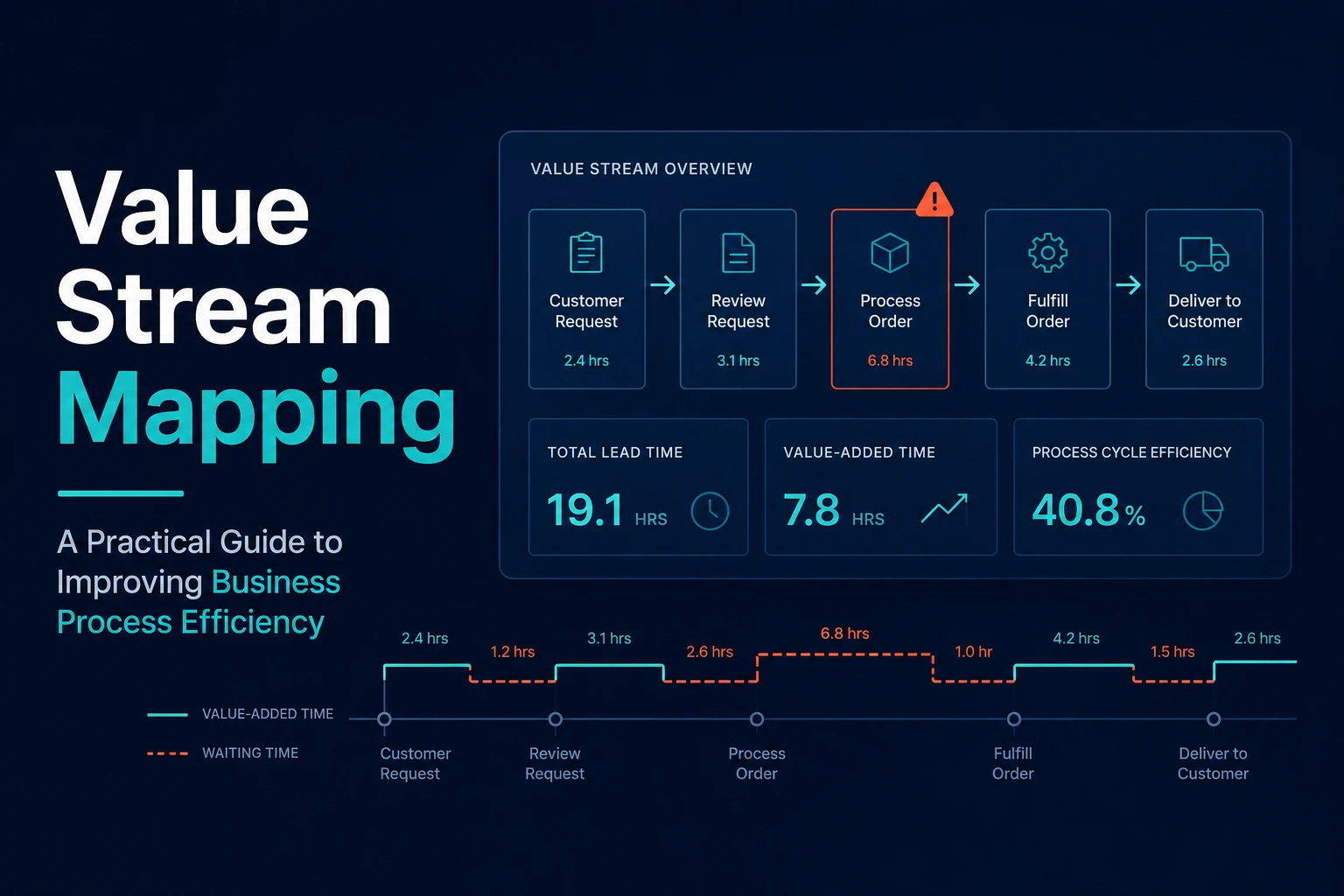
This is where value stream mapping becomes an essential business improvement tool. Rather than making assumptions about why processes fail, value stream mapping provides a visual representation of how work actually moves from beginning to end. It helps organizations identify inefficiencies, eliminate unnecessary activities, and build smoother workflows that create more value for customers.
Whether you work in manufacturing, software development, healthcare, logistics, finance, or professional services, value stream mapping provides practical insights that support better decision making and continuous improvement. It transforms complicated workflows into clear diagrams that reveal where time, effort, and resources are being lost.
This guide explains what value stream mapping is, why it matters, how businesses use it, and how it supports long term business process optimization.
What Is Value Stream Mapping?
Value stream mapping is a visual method used to analyze every step involved in delivering a product or service. The goal is to understand how value flows through an organization while identifying activities that create delays, waste, or unnecessary costs.
Unlike a basic process map that simply illustrates the sequence of tasks, a value stream map includes valuable operational information such as lead time, cycle time, inventory levels, waiting periods, communication paths, and information flow.
The result is a complete picture of both the physical and informational processes required to deliver value to customers.
A typical value stream map answers questions such as:
- Where does work slow down?
- Which activities actually create customer value?
- Which tasks consume time without improving the final product?
- Where do approvals or handoffs create delays?
- Which stages create unnecessary rework?
By answering these questions, businesses gain the information needed to improve operational performance instead of relying on assumptions.
Why Value Stream Mapping Matters
Many organizations invest heavily in automation, new technology, or additional staff without fully understanding where inefficiencies exist. Unfortunately, adding resources to a broken process often increases complexity instead of improving performance.
Value stream mapping encourages organizations to examine the entire workflow before implementing solutions.
The benefits include:
Better Visibility Across Operations
Many departments only understand the portion of the workflow they directly manage. A value stream map connects every stage into one complete picture, allowing teams to understand how their work affects the entire business.
This shared visibility improves collaboration while reducing communication gaps between departments.
Stronger Business Process Optimization
Business process optimization focuses on improving efficiency while reducing unnecessary effort.
Value stream mapping supports this objective by identifying:
- Duplicate activities
- Excess approvals
- Long waiting periods
- Manual data entry
- Unnecessary transportation
- Communication bottlenecks
- Rework caused by poor quality
Removing these inefficiencies creates faster, more reliable workflows.
Improved Customer Satisfaction
Customers rarely notice internal business activities. They care about receiving high quality products and services quickly.
By shortening lead times and reducing errors, organizations improve customer experiences while increasing trust and loyalty.
Data Driven Decision Making
Rather than relying on opinions, value stream mapping provides measurable information that supports process improvement initiatives.
Teams can prioritize improvements based on actual operational data instead of assumptions.
Understanding Value Added and Non Value Added Activities
One of the most important concepts in value stream mapping involves distinguishing between value added and non value added work.
Value Added Activities
A value added activity directly contributes to what the customer is willing to pay for.
Examples include:
- Manufacturing a product
- Developing software features
- Performing medical treatment
- Providing professional consulting
- Assembling customer orders
These activities move work closer to completion while creating customer value.
Non Value Added Activities
Non value added activities consume time and resources without improving the final outcome.
Examples include:
- Waiting for approvals
- Searching for information
- Duplicate documentation
- Manual data transfer
- Excess inventory
- Rework caused by defects
- Multiple quality inspections
Reducing these activities significantly improves operational efficiency.
Key Components of a Value Stream Map
Although every organization creates customized maps, most include several standard components.
Process Steps
These represent each stage required to complete work.
Information Flow
Information flow illustrates how instructions, approvals, schedules, and customer requests move throughout the organization.
Poor information flow often creates delays even when production activities operate efficiently.
Material Flow
For manufacturing businesses, material flow tracks how products move between workstations.
For service organizations, this may represent documents, digital files, or customer requests.
Lead Time
Lead time measures the total time required to complete the entire process.
This includes both productive work and waiting time.
Cycle Time
Cycle time measures the actual time spent performing work at each process step.
Comparing lead time with cycle time often reveals surprisingly large waiting periods.
Inventory or Work in Progress
These indicators show where unfinished work accumulates.
Large backlogs often signal process bottlenecks.
Common Sources of Waste
Value stream mapping frequently reveals waste that has gradually become accepted as normal.
Common examples include:
Waiting
Employees waiting for approvals, equipment, materials, or information.
Overprocessing
Performing unnecessary reviews or creating reports that provide little value.
Defects
Errors requiring correction, rework, or replacement.
Transportation
Moving products or information unnecessarily between locations or systems.
Motion
Employees spend excessive time searching for files, equipment, or documentation.
Excess Inventory
Large amounts of unfinished work increase lead times while hiding operational problems.
Unused Talent
Employees often possess ideas for improvement that remain overlooked.
Recognizing these forms of waste helps organizations build more efficient workflows.
How to Create a Value Stream Map
Successful value stream mapping follows a structured approach.
Define the Scope
Choose one product, service, or business process.
Attempting to map an entire organization at once usually creates unnecessary complexity.
Observe the Current Process
Collect information by observing work directly rather than relying solely on documentation.
Employees performing daily tasks often provide the most accurate insights.
Gather Performance Data
Measure:
- Lead time
- Cycle time
- Waiting time
- Error rates
- Process capacity
- Inventory levels
- Customer demand
Reliable data produces more effective improvement opportunities.
Build the Current State Map
Visualize the existing workflow exactly as it operates today.
Avoid designing the ideal process during this stage.
Identify Improvement Opportunities
Look for:
- Bottlenecks
- Delays
- Duplicate work
- Manual activities
- Communication failures
- Resource imbalances
These observations become improvement priorities.
Design the Future State
Create an improved workflow that removes unnecessary activities while maintaining quality.
The future state should balance efficiency with practical implementation.
Value Stream Mapping Beyond Manufacturing
Although value stream mapping originated within lean manufacturing, it now supports many industries.
Software Development
Development teams use value stream mapping to improve deployment pipelines, reduce release delays, and accelerate feature delivery.
Healthcare
Hospitals use value stream mapping to improve patient flow, reduce waiting times, and streamline administrative processes.
Financial Services
Banks improve loan approvals, compliance processes, and customer onboarding.
Supply Chain Management
Logistics organizations optimize inventory movement, warehouse operations, and transportation planning.
Government
Public agencies simplify administrative procedures while improving citizen services.
Professional Services
Consulting firms improve proposal development, project delivery, and client communication.
The principles remain consistent regardless of industry.
Technology and Digital Value Stream Mapping
Modern organizations increasingly rely on digital platforms to create, maintain, and analyze value stream maps.
Digital solutions provide advantages such as:
- Real time collaboration
- Automated data collection
- Cloud accessibility
- Performance dashboards
- Version control
- Integration with project management tools
- Continuous workflow monitoring
These capabilities allow businesses to keep process documentation current rather than treating value stream mapping as a one time exercise.
Common Mistakes to Avoid
Many organizations struggle with value stream mapping because they focus on documentation instead of improvement.
Common mistakes include:
Mapping Without Data
Accurate measurements produce better decisions than assumptions.
Ignoring Employee Input
Frontline employees often understand workflow challenges better than management.
Focusing Only on Individual Departments
True optimization requires understanding the complete value stream across the organization.
Creating Maps That Are Never Updated
Business processes change regularly.
Maps should evolve alongside operational improvements.
Automating Inefficient Processes
Technology should improve workflows, not preserve existing inefficiencies.
Measuring Success After Implementation
After implementing improvements, organizations should monitor measurable outcomes.
Useful performance indicators include:
- Reduced lead time
- Lower cycle time
- Increased throughput
- Higher customer satisfaction
- Fewer process defects
- Reduced operating costs
- Improved employee productivity
- Shorter response times
- Better resource utilization
Continuous monitoring ensures improvements remain sustainable.
Building a Culture of Continuous Improvement
Value stream mapping is not simply a documentation exercise. It supports a broader culture of continuous improvement where teams regularly evaluate how work is performed and identify opportunities to deliver greater customer value.
Businesses that consistently review workflows become more adaptable, resilient, and competitive. Rather than waiting for major operational problems, they make incremental improvements that compound over time.
Encouraging collaboration across departments, collecting performance data, and empowering employees to suggest improvements creates an environment where optimization becomes part of everyday operations.
Conclusion
Value stream mapping gives organizations a practical framework for understanding how work moves through their business. By visualizing workflows, measuring performance, and identifying waste, companies can make informed decisions that improve operational efficiency and strengthen customer satisfaction.
As organizations continue pursuing business process optimization, value stream mapping remains one of the most effective methods for uncovering hidden inefficiencies and creating lasting improvements. Whether your goal is reducing lead times, improving quality, streamlining business operations, or supporting digital transformation, a well developed value stream map provides the clarity needed to optimize processes with confidence.
Businesses that embrace value stream mapping as an ongoing practice rather than a one time project position themselves for sustainable growth, operational excellence, and continuous improvement in an increasingly competitive marketplace.