
Digital Value Stream Mapping: Why Modern Process Improvement Teams Need More Than Static Process Maps
Every organization depends on business processes that connect people, technology, and information to deliver value to customers. As these processes become increasingly digital, traditional methods of documenting workflows often struggle to keep pace with the speed of modern business.
Many organizations still rely on whiteboards, spreadsheets, sticky notes, or static diagrams to understand how work flows across departments. While these methods can be useful during workshops, they quickly become outdated as processes evolve. Teams end up making critical operational decisions based on documentation that no longer reflects reality.
This is why Digital Value Stream Mapping has become an essential capability for organizations pursuing operational excellence and digital transformation.
Instead of treating value stream maps as one-time documents, digital value stream mapping creates a dynamic, collaborative view of business operations. It enables process improvement teams to continuously analyze workflows, identify inefficiencies, and prioritize improvements using real operational data.
For organizations looking to reduce waste, improve delivery speed, and build more efficient operations, digital value stream mapping provides a smarter foundation for long-term business process optimization.
What Is Digital Value Stream Mapping?
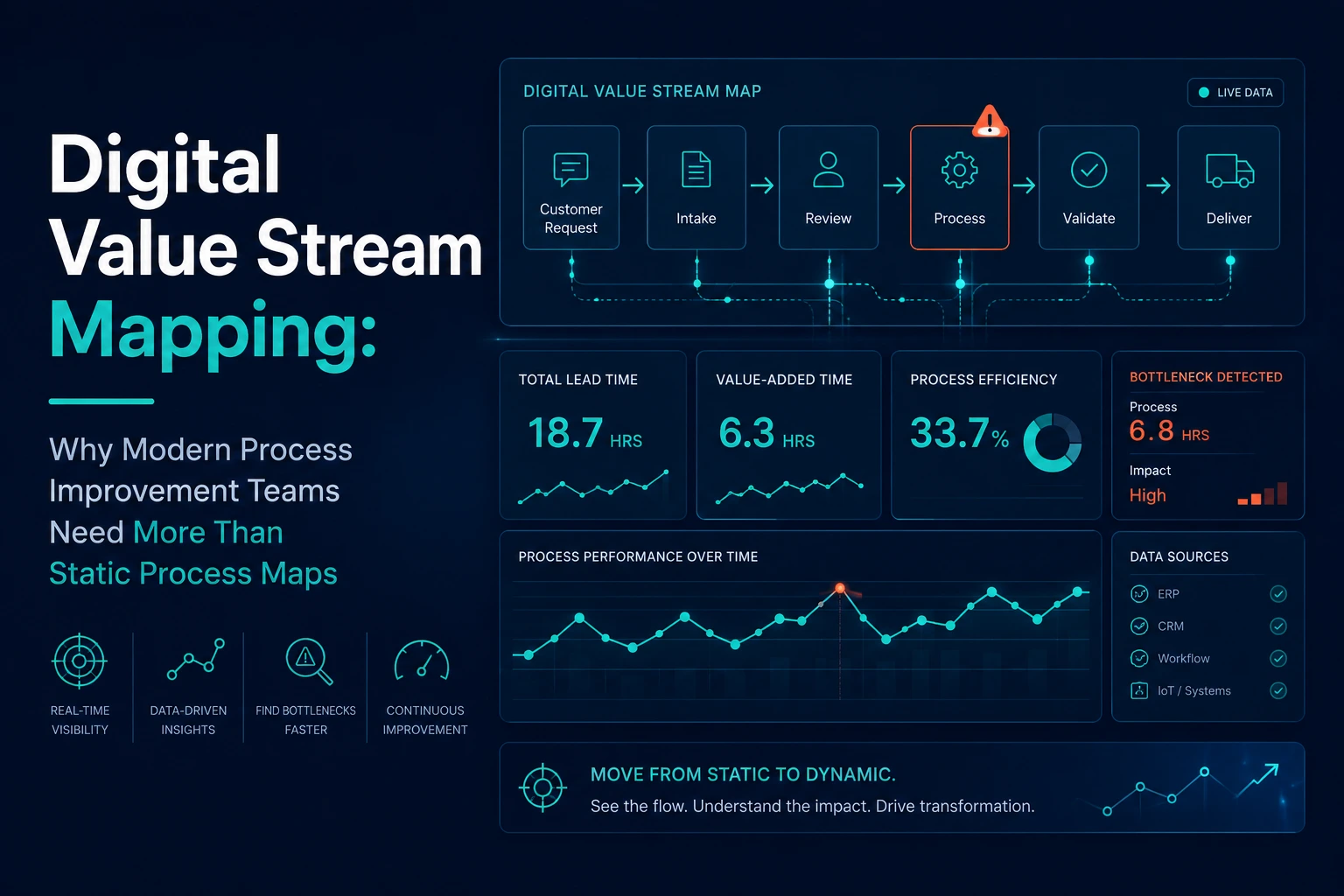
Digital value stream mapping is the modern evolution of traditional value stream mapping. It combines lean improvement principles with digital collaboration, real-time operational insights, and process analysis tools to provide a more accurate picture of how value moves through an organization.
Rather than relying solely on manual observations and printed diagrams, digital value stream mapping allows organizations to create living process maps that evolve alongside their business.
These digital maps help organizations visualize:
- End-to-end business workflows
- Information flow
- Process dependencies
- Customer value creation
- Lead times
- Cycle times
- Workflow bottlenecks
- Process delays
- Operational metrics
- Opportunities for continuous improvement
Because the maps are maintained digitally, they remain accessible, shareable, and significantly easier to update than traditional documentation.
Why Static Process Maps No Longer Meet Business Needs
Business processes are constantly changing.
New software is introduced.
Departments are reorganized.
Customer expectations evolve.
Automation replaces manual tasks.
Regulatory requirements shift.
Unfortunately, many organizations continue using process documentation created months or even years earlier.
The result is a disconnect between documented workflows and actual operations.
Static process maps create several challenges.
Limited Visibility
Traditional maps often represent only a snapshot in time.
As soon as operational changes occur, the documentation becomes less accurate.
Difficult Collaboration
Paper-based maps or disconnected documents make it difficult for cross-functional teams to collaborate effectively.
Multiple versions quickly emerge, creating confusion about which process is correct.
Slow Decision-Making
When process information is outdated, improvement initiatives are delayed while teams spend valuable time validating existing workflows.
Lost Improvement Opportunities
Hidden bottlenecks often remain undiscovered because process documentation cannot easily capture changing operational conditions.
Digital value stream mapping addresses each of these limitations by creating a collaborative environment where workflows remain current and continuously improve.
Digital Value Stream Mapping Supports Modern Business Process Optimization
Today’s organizations operate across multiple business systems.
Enterprise Resource Planning platforms.
Customer Relationship Management software.
Project management tools.
Workflow automation platforms.
Cloud applications.
Business intelligence dashboards.
Each system contains valuable operational data, yet many organizations struggle to understand how these systems work together to create customer value.
Digital value stream mapping brings these operational insights together into one visual framework.
Instead of viewing isolated systems, process improvement teams gain visibility into the complete value stream.
This broader perspective supports more effective business process optimization by revealing opportunities that individual departments may never recognize on their own.
Key Benefits of Digital Value Stream Mapping
Organizations investing in digital value stream mapping often experience improvements across multiple areas of the business.
Better Cross-Functional Collaboration
Operational improvements rarely occur within a single department.
Successful transformation requires collaboration between operations, technology, finance, customer service, compliance, and leadership.
Digital platforms allow every stakeholder to contribute to the same value stream map, improving communication while reducing misunderstandings.
Everyone works from the same version of the truth.
Faster Identification of Process Bottlenecks
Many operational delays remain hidden because organizations only measure departmental performance.
Digital value stream mapping reveals how delays accumulate across the entire customer journey.
Common bottlenecks include:
- Approval delays
- Manual handoffs
- Duplicate data entry
- Resource constraints
- Communication gaps
- Excess waiting time
- Rework caused by quality issues
Identifying these issues earlier allows organizations to prioritize improvements with greater confidence.
Greater Operational Transparency
Leaders often receive reports showing performance metrics without understanding why those numbers exist.
Digital value stream mapping connects operational metrics directly to workflow activities.
Instead of asking why customer delivery takes three weeks, leaders can identify exactly where delays occur.
This transparency supports faster and more informed decision-making.
Continuous Process Improvement
Traditional value stream maps often remain unchanged after a workshop concludes.
Digital maps evolve continuously.
As workflows improve, documentation remains current.
This supports ongoing Lean initiatives instead of one-time improvement projects.
Digital Value Stream Mapping Enables Smarter Digital Transformation
Digital transformation is about improving how organizations operate through technology.
Unfortunately, many digital transformation initiatives focus primarily on software implementation rather than operational improvement.
Technology should improve business processes.
It should not compensate for inefficient workflows.
Digital value- stream mapping ensures organizations first understand how work flows across the business before introducing automation or new technology.
This approach significantly improves implementation success while reducing unnecessary investment.
Organizations frequently use digital value stream mapping before:
- Workflow automation
- Enterprise software implementation
- Cloud migration
- Process standardization
- Shared service initiatives
- Customer experience improvement
- Lean transformation
- Organizational restructuring
Starting with workflow visibility creates stronger business outcomes.
Features to Look for in Digital Value Stream Mapping Software
Not every mapping solution provides the capabilities required for modern process improvement.
When evaluating digital value- stream mapping software, organizations should consider several essential features.
Real-Time Collaboration
Multiple stakeholders should be able to contribute simultaneously regardless of location.
Process Visualization
The platform should provide intuitive visual workflows that are easy for technical and non-technical teams to understand.
Performance Metrics
Operational data should be integrated directly into value stream maps.
This allows teams to connect workflow performance with measurable business outcomes.
Version Control
As workflows evolve, organizations should maintain historical records while ensuring everyone works from the latest process design.
Scalability
The platform should support growth from individual improvement projects to enterprise-wide transformation programs.
Integration Capabilities
Modern organizations use multiple digital platforms.
Value stream mapping software should integrate with existing business systems whenever possible.
Common Challenges Solved by Digital Value Stream Mapping
Many organizations recognize operational problems but struggle to determine where improvements should begin.
Digital value stream mapping addresses several common business challenges.
Long Customer Lead Times
By visualizing the complete customer journey, organizations identify unnecessary waiting periods that extend delivery times.
Inconsistent Processes
Digital maps help standardize workflows across departments and locations.
Poor Resource Utilization
Teams gain visibility into workload distribution, making it easier to balance capacity.
Limited Process Ownership
Clearly documented workflows improve accountability while defining responsibilities across the organization.
Siloed Departments
Cross-functional visibility encourages collaboration instead of departmental optimization.
Why Process Improvement Teams Choose Digital Mapping Over Manual Documentation
Manual process documentation requires significant effort to maintain.
Changes often involve:
Updating diagrams.
Distributing new versions.
Reviewing documentation manually.
Confirming stakeholder approval.
Repeating the process after every operational change.
Digital value stream mapping simplifies this process considerably.
Updates become immediate.
Teams collaborate in real time.
Documentation remains accessible across the organization.
Leadership gains current operational visibility whenever decisions need to be made.
Instead of maintaining documentation, process improvement teams spend more time delivering measurable business improvements.
When Should Your Organization Adopt Digital Value Stream Mapping?
Digital value- stream mapping delivers the greatest value during periods of organizational change.
Ideal situations include:
Preparing for digital transformation.
Scaling business operations.
Launching continuous improvement initiatives.
Improving customer experience.
Reducing operational costs.
Implementing workflow automation.
Supporting Lean programs.
Standardizing enterprise processes.
If your organization regularly manages complex workflows involving multiple departments, digital value stream mapping can provide significant operational advantages.
Why Professional Guidance Accelerates Results
Although many organizations begin mapping processes internally, experienced value- stream mapping specialists often help businesses achieve faster and more sustainable improvements.
External consultants provide an objective perspective while bringing proven methodologies developed across multiple industries.
Rather than simply documenting workflows, experienced consultants help organizations:
Identify hidden waste.
Prioritise improvement opportunities.
Facilitate stakeholder workshops.
Develop realistic implementation roadmaps.
Align improvement initiatives with business goals.
Support change management throughout transformation projects.
For many organizations, expert guidance shortens the path from process discovery to measurable business results.
Digital Value Stream Mapping Is an Investment in Long-Term Operational Excellence
Business environments continue evolving faster than ever.
Customer expectations continue rising.
Technology advances rapidly.
Competition becomes increasingly complex.
Organizations that rely on outdated process documentation struggle to adapt.
Digital value stream mapping provides a modern framework for understanding how work truly flows across the business.
It creates visibility where complexity previously existed.
It supports collaboration where departments once operated independently.
Most importantly, it enables process improvement teams to make confident decisions based on accurate operational insights rather than assumptions.
Transform Your Processes With Digital Value Stream Mapping
If your organization is preparing for a transformation initiative, implementing workflow automation, or improving operational performance, the first step should be understanding your current value stream.
A professional digital value stream mapping engagement helps process improvement teams uncover hidden inefficiencies, align stakeholders, and build a practical roadmap for sustainable business process optimization.
Instead of relying on outdated documentation or disconnected process diagrams, gain a complete digital view of your business operations and identify the improvements that will create the greatest impact.
Request a consultation today to learn how Digital Value Stream Mapping can help your organization streamline workflows, improve operational efficiency, accelerate transformation initiatives, and deliver greater value to your customers.