
Why Process Improvement Teams Need Value Stream Mapping Before Their Next Transformation Project
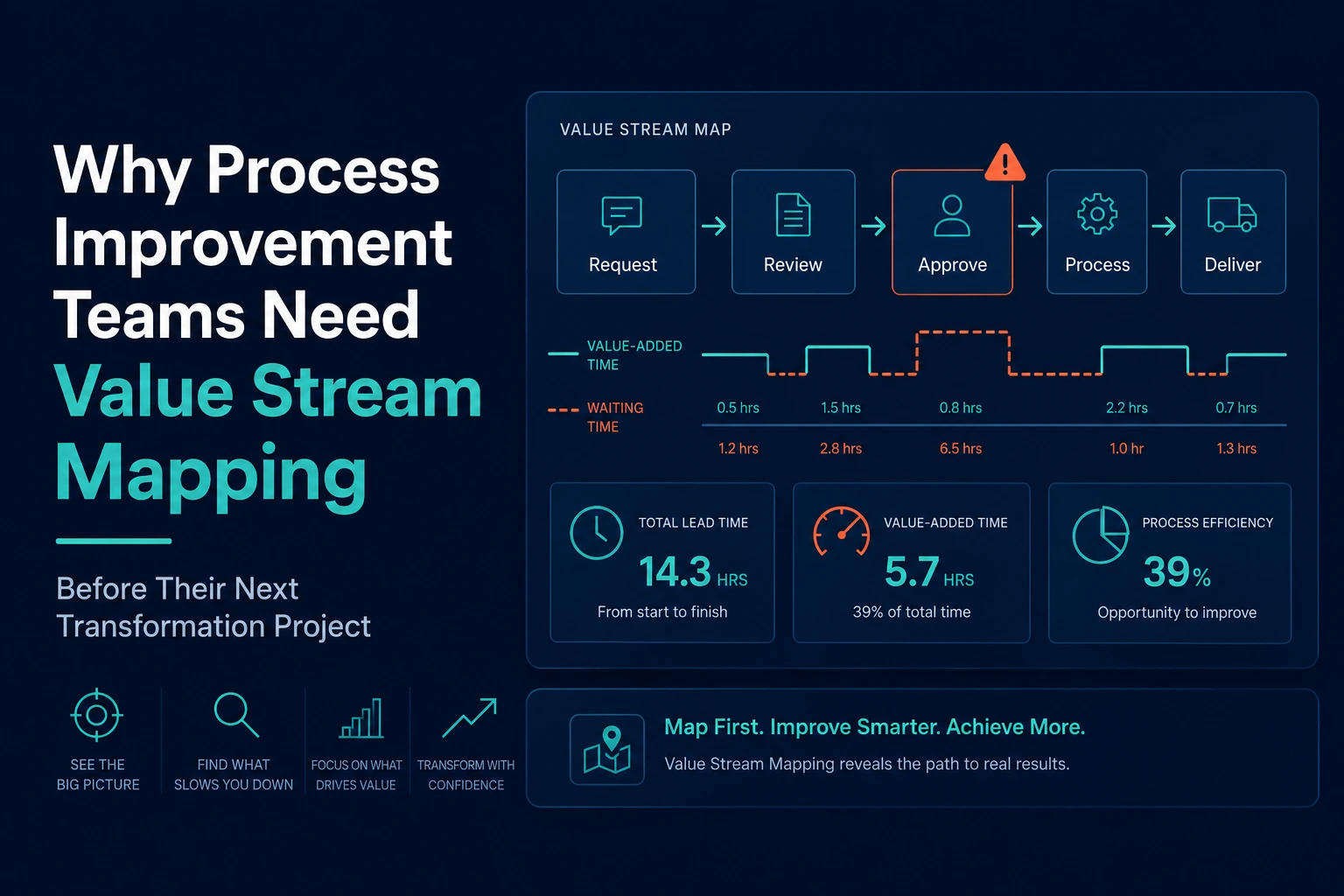
Every organization reaches a point where existing processes can no longer keep pace with business demands. Customer expectations increase, operational costs continue to rise, and teams struggle with workflows that have gradually become more complicated over time. Leadership recognizes that change is necessary, but determining where to begin is often the biggest challenge.
Many companies immediately invest in new software, automation platforms, or large transformation initiatives. While these investments can deliver significant value, they frequently fail to produce the expected results because the underlying processes were never fully understood.
This is why successful transformation projects almost always begin with value stream mapping.
Rather than making assumptions about where problems exist, value- stream- mapping provides a complete picture of how work moves throughout an organization. It reveals inefficiencies, uncovers hidden bottlenecks, and identifies opportunities that can significantly improve operational performance before expensive changes are implemented.
For process improvement teams responsible for driving operational excellence, value stream mapping is often the difference between a transformation that delivers measurable business outcomes and one that simply replaces old problems with new technology.
Why Most Process Improvement Initiatives Miss Their Targets
Business leaders rarely lack motivation to improve operations. The challenge lies in identifying the real source of operational friction.
Many improvement projects focus on symptoms instead of root causes.
An organization may notice delayed customer deliveries and assume additional staff are required. Another may experience declining productivity and purchase new workflow software. Others may introduce automation to speed up processes without understanding why delays occur in the first place.
These approaches often create temporary improvements while leaving the underlying inefficiencies untouched.
Business process optimization begins with visibility.
Until every step in a workflow is clearly understood, it becomes difficult to determine which improvements will produce meaningful results.
That visibility is exactly what value stream mapping provides.
Value Stream Mapping Creates a Shared Understanding
One of the biggest challenges facing process improvement teams is that every department views the business from a different perspective.
Sales focuses on customer acquisition.
Operations concentrate on delivery.
Finance prioritizes cost control.
Customer service manages ongoing relationships.
Technology supports the systems behind every process.
Each team understands its own responsibilities, but very few people have visibility across the complete customer journey.
Value-Stream mapping brings every stakeholder together around a single visual representation of how value flows through the organization.
Instead of debating opinions, teams begin discussing facts.
Questions become easier to answer.
Where does work stop?
Why are approvals delayed?
Which handoffs create unnecessary waiting?
Where do customers experience the longest delays?
Once everyone works from the same picture, collaboration becomes significantly more productive.
The Hidden Costs of Inefficient Processes
Many operational problems remain invisible because organizations have gradually adapted to them.
Employees become accustomed to manual workarounds.
Multiple approvals become standard practice.
Teams accept long waiting periods between departments.
Duplicate data entry becomes part of daily operations.
These activities rarely appear on financial reports, yet they consume thousands of productive hours each year.
Common hidden costs include:
- Extended project timelines
- Increased labor expenses
- Higher operational costs
- Reduced employee productivity
- Customer frustration
- Missed revenue opportunities
- Inconsistent service quality
- Increased process complexity
Value stream mapping exposes these hidden costs by documenting every activity involved in delivering customer value.
Once identified, many inefficiencies become surprisingly straightforward to eliminate.
Why Technology Alone Cannot Solve Process Problems
Digital transformation continues to reshape every industry.
Automation platforms, artificial intelligence, enterprise resource planning systems, and workflow management software promise faster operations and improved productivity.
However, technology is only as effective as the process it supports.
Automating an inefficient workflow simply allows the organization to perform inefficient work more quickly.
For example, if multiple unnecessary approvals delay customer onboarding, automating those approvals may reduce processing time slightly but will not eliminate the unnecessary steps themselves.
The smarter approach is to first evaluate the workflow through value stream mapping.
Only after unnecessary activities have been removed should automation be introduced.
This approach maximizes return on technology investments while reducing implementation risks.
What Process Improvement Teams Gain From Value Stream Mapping
Successful organizations view value- stream mapping as more than a documentation exercise.
It becomes the foundation for continuous improvement.
Better Decision-Making
Rather than relying on assumptions, improvement teams gain measurable operational data that supports strategic decisions.
This reduces uncertainty when prioritizing improvement initiatives.
Clear Improvement Priorities
Not every operational issue deserves immediate attention.
Value stream mapping helps identify which bottlenecks create the greatest impact on customer value, allowing teams to focus resources where they generate the highest return.
Stronger Cross-Functional Collaboration
Transformation projects often fail because departments optimize individual workflows instead of improving the complete business process.
Value stream mapping aligns every team around shared business objectives.
Greater Operational Visibility
Leadership gains a comprehensive understanding of process performance across the organization instead of reviewing isolated departmental metrics.
Business Process Optimization Starts With Understanding Current Reality
One common mistake organizations make is designing future processes before fully understanding the current state.
Without accurate knowledge of today’s workflow, improvement efforts are based largely on assumptions.
A current state value stream map provides valuable insights, including:
- Existing process steps
- Information flow
- Customer demand
- Lead times
- Cycle times
- Waiting periods
- Process bottlenecks
- Resource utilization
- Quality issues
- Communication gaps
Only after documenting current reality should future improvements be designed.
This structured approach reduces implementation risks while increasing the likelihood of measurable business improvements.
When Should an Organization Invest in Value Stream Mapping?
Process improvement teams often ask when value stream mapping delivers the greatest return.
Several situations consistently benefit from a comprehensive assessment.
Before Digital Transformation
Understanding current workflows prevents technology investments from reinforcing inefficient processes.
Prior to Business Expansion
Growth often magnifies operational problems.
Improving workflows before expansion creates a stronger operational foundation.
Following Mergers or Acquisitions
Combining multiple business processes frequently introduces duplication and complexity.
Value stream mapping helps create a unified operating model.
During Operational Excellence Programmes
Continuous improvement initiatives become significantly more effective when supported by accurate workflow analysis.
Before Large Automation Projects
Automation produces stronger outcomes after unnecessary work has already been eliminated.
Why External Expertise Often Accelerates Results
Although many organizations create value- stream maps internally, experienced consultants often uncover opportunities that internal teams overlook.
External specialists bring several advantages.
They offer objective analysis without departmental bias.
They have experience across multiple industries and understand proven improvement strategies.
They facilitate workshops that encourage productive collaboration between departments.
They help organizations move from identifying problems to implementing practical solutions.
Perhaps most importantly, experienced consultants understand how to prioritize improvements that deliver measurable business outcomes instead of creating lengthy lists of potential enhancements.
For many organizations, this significantly shortens the path from analysis to implementation.
What to Expect From a Value Stream Mapping Engagement
A structured value- streaming engagement typically follows several stages.
The process begins with stakeholder discussions to understand business objectives and define project scope.
Operational data is then collected through observations, interviews, and workflow analysis.
The current state map is created to document existing processes.
Improvement opportunities are evaluated based on business impact.
Finally, a future state roadmap outlines recommended process improvements along with practical implementation priorities.
Rather than producing documentation that sits unused, the objective is to create a realistic action plan that supports measurable operational improvements.
The Business Outcomes That Matter Most
Organizations invest in business process optimization because they expect measurable results.
When value stream mapping is combined with effective implementation, common outcomes include:
- Faster process completion
- Reduced operating costs
- Improved customer satisfaction
- Higher employee productivity
- Better resource utilization
- Reduced process variation
- Increased workflow transparency
- Stronger collaboration across departments
- Improved operational resilience
- Greater organizational agility
These improvements extend beyond individual departments and often influence overall business performance.
Why Continuous Improvement Never Stops
Business environments continue to evolve.
Customer expectations change.
Technology advances.
Markets become more competitive.
Processes that perform well today may require adjustment tomorrow.
This is why leading organizations treat value- stream mapping as an ongoing management practice rather than a one-time project.
Regular workflow reviews allow businesses to identify emerging inefficiencies before they become costly operational problems.
Continuous improvement creates a culture where optimization becomes part of everyday decision-making instead of an occasional transformation initiative.
Your Next Transformation Should Begin With Clarity
Every successful transformation starts with understanding how work truly flows through the organization.
Without that understanding, improvement initiatives often rely on assumptions that increase project risk and reduce return on investment.
Value stream mapping provides the clarity needed to make confident business decisions.
It identifies where customer value is created, where resources are being lost, and where improvement efforts will have the greatest impact.
Whether your organization is preparing for digital transformation, improving operational efficiency, reducing costs, or enhancing customer experience, value- stream mapping establishes the foundation for sustainable success.
Request a Value Stream Mapping Consultation
If your process improvement team is preparing for a transformation initiative, now is the ideal time to evaluate your existing workflows before investing in new technology or large-scale operational changes.
A professional value stream mapping consultation can help your organization identify hidden inefficiencies, prioritize improvement opportunities, and develop a practical roadmap for business process optimization.
Instead of guessing where problems exist, gain a clear understanding of your workflows through expert analysis and actionable recommendations.
Request a consultation today to discover how value-reaming mapping can help your organization improve operational efficiency, reduce waste, and build processes that support long-term business growth.